Stories
América Latina y el Caribe
11-08-2026
Research on access to land in Latin America requires overcoming “structural inequality” and promoting community governance
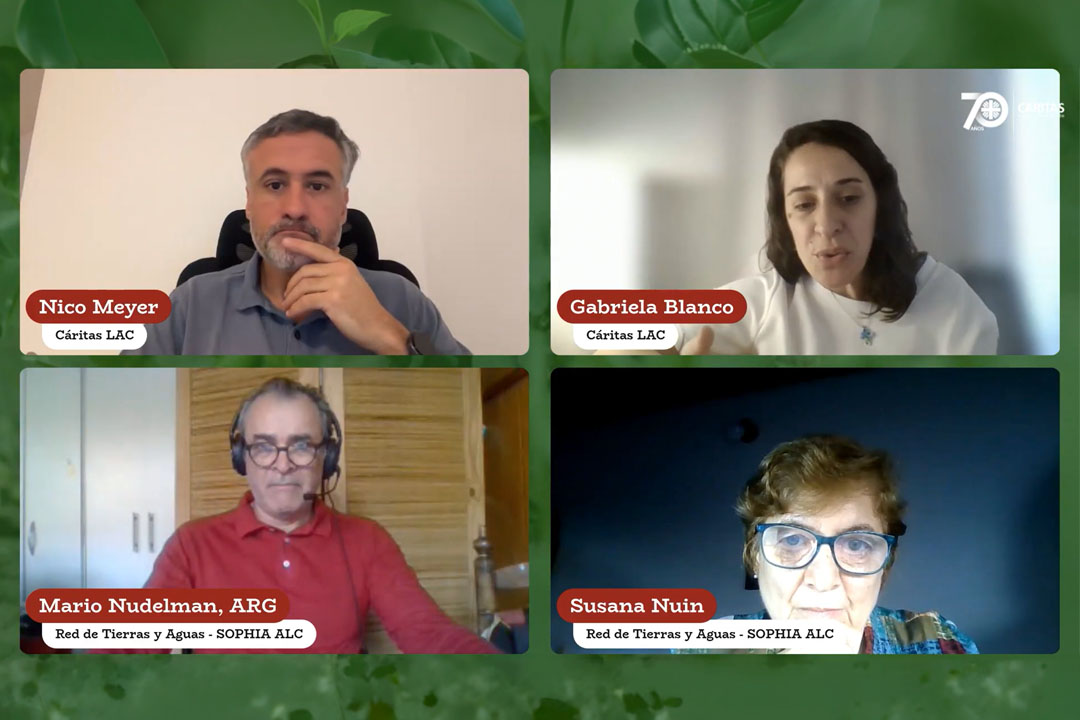
In response to the persistent clamor of rural people and the call of Pope Francis for the “3Ts” (Land, Shelter and Work), Cáritas Latin America and the Caribbean, in coordination with the SOPHIA University Institute and the Latin American and Caribbean Land and Water Program, officially presented the regional research entitled "Right to access to land and its governance in Latin America and the Caribbean.".
The study, prepared over several months by a team of more than 25 researchers from various countries in Latin America and the Caribbean, seeks to systematize scientific evidence to support the territorial struggles of peasants, indigenous people and Afro-descendants, transforming the experience of the territory into inputs for public policies and pastoral advocacy.
Evidence to amplify the voices of the territory
During the opening of the event, Nicolás Meyer, Regional Coordinator of Cáritas Latin America and the Caribbean, highlighted the urgency of providing scientific rigor to the pastoral accompaniment carried out by the Church in local communities.
We need the cry of the earth to have evidence, to have more robustness and body. Because? Because in this way we will be able to amplify and enhance the voice, give it scientific rigor and show that they are not just opinions or isolated experiences, but a tangible and objective reality that invites us to action and transform it into public policies and pastoral decisions.
Meyer also emphasized that the report was born with the vocation of being a “living document”, accessible for consultation and debate in grassroots communities and not only in public spaces. academics.
A systemic and interdisciplinary method
The technical coordination of the research was in charge of Susana Nuin, who explained the methodology applied in the four chapters that make up the work: data collection on agrarian reforms and the role of the Church; biblical, anthropological and theological foundations; 14 testimonies of successful experiences in the right of access to land; and a deep analysis of governance models.
It was a study that is based on a critical, testimonial and prophetic foundation. (...) It allowed us to do work that did not cover isolated topics, but rather understood realities in the light of anthropological, biblical and pastoral principles.
Faced with the questioning of the link between faith and agrarian themes, Nuin stressed: “The anthropological right of the person over space and territory is constitutive of the person and communities, and this emerges from the Ancient Testament.”.
Structural inequality and the difference between governability and governance
For his part, Mario Nudelman, co-director of the research, pointed out that the starting point of the study was to confirm the persistence of a historical injustice in the distribution of land.
The starting hypothesis that we have verified is the presence of a structural inequality regarding the distribution of land in Latin America. This remains an unsolved problem and inequality remains the Gordian knot.
Nudelman made a key conceptual distinction between governability (the exercise of power by elected governments) and governance. He explained that States are indispensable but insufficient actors in the face of the complexity of climate change and the presence of transnational corporations, which is why it is necessary to build dialogue tables where local communities, the private sector and social organizations establish equitable rules of the game.
The study rescues various successful experiences that demonstrate the viability of fair land management. To access the complete publication and download it for free, click here. The team prepared a didactic version in the format of an interactive concept map that is at available at this link.
You can watch the complete broadcast of the launch event and access the reflections of the panelists through the official channel of Cáritas Latin America and the Caribbean or by clicking directly on the video below.
Care of the common home and Holistic Human Development