Stories
América Latina y el Caribe
31-08-2026
Towards a Church that protects and cares: regional webinar presents tools to promote the culture of care
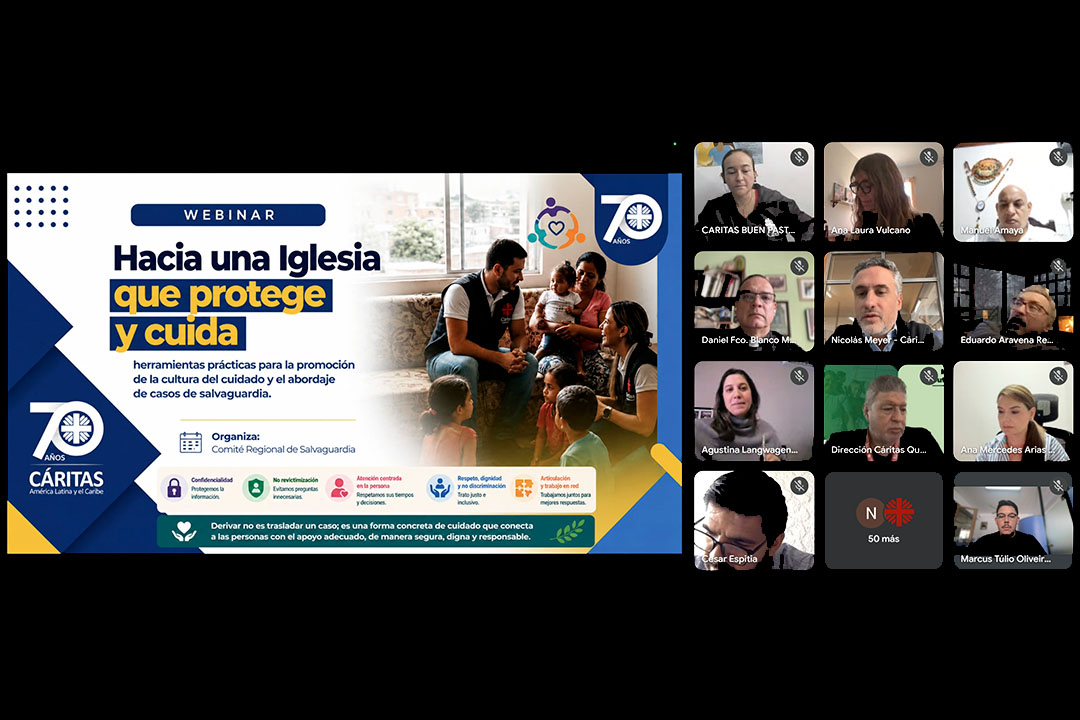
The Regional Safeguarding Committee developed the webinar “Towards a Church that protects and cares: practical tools for promoting the culture of care and addressing safeguarding cases”, on Wednesday, August 26, virtually, with the participation of 120 people from the entire Cáritas Latin America and the Caribbean region, including representatives of the National Cáritas, dioceses, parishes and religious communities. The webinar was conceived as a space to share concrete tools that allow progress from institutional commitments towards daily practices of prevention, protection and care.
The meeting is part of the path that the region has been taking to consolidate Safeguarding not only as a set of policies and protocols, but as an institutional culture of care, capable of preventing risks, protecting the dignity of people and offering safe, timely and focused responses to those who go through situations of violation.
From principles to concrete tools
During the webinar, the Practical subsidies for addressing safeguarding cases and promoting the culture of care were presented, developed from needs identified in the Cáritas of the region. Click to access the subsidies.
These tools seek to complement existing policies and protocols and facilitate their application in specific situations, articulated around four fundamental actions: prepare, listen, respond and articulate protection, always maintaining the person at the center.
Throughout the meeting, the members of the Regional Safeguarding Committee deepened fundamental aspects such as institutional responsibility and accountability, the creation of safe reporting channels, listening without re-victimization, ethical accompaniment, mapping of services and referral routes, as well as psychological first aid and the care of those they accompany. The inputs make up the publication Regional Guide for Institutional Response in Safeguarding: tools to strengthen the culture of care. Click to download the guide for free.
One of the central messages was the centrality of the person in relation to institutional action and the importance of reducing improvisation in situations of violation. To this end, Cáritas were invited to identify and keep updated their local support networks—health services, psychosocial care, protection, legal advice, social organizations and spiritual accompaniment—and establish clear and safe routes for referral.
Psychological first aid was also addressed as an initial response that does not replace specialized care, but rather seeks to offer human presence, active listening, help regain calm and identify immediate needs to connect the person with support networks.
Continue building a culture of care
The meeting reaffirmed that Safeguarding is a shared responsibility and a process that requires continuing to strengthen capacities, structures and practices at all levels of the network. The challenge is to continue advancing so that the commitments assumed are increasingly translated into gestures, decisions and concrete care practices, strengthening organizations capable of preventing, listening, responding and learning.

Identity and spirituality